Exploring narrative in Chinatown (1974) directed by Roman Polanski
Chinatown includes several narrative conventions of the thriller genre. However, most of these are specific to the film noir period. For example, the twist regarding Mrs. Mulwray’s (Faye Dunaway) unfortunate past is an almost perfect example of one of the crucial noir themes: the haunted past. Other themes in Chinatown, such as the corruption of the water company, wouldn’t go missing in a noir either, and this theme of corruption is in fact a vital part of the narrative of both Chinatown and a vast amount of noirs, as it is an excellent example of another essential noir theme: the fatalistic nightmare. Another example of the same theme in Chinatown is the bleak and unresolved ending, for the unfortunate Mrs. Mulwray gets shot, whilst the viewer is left knowing that a dark and unhappy future awaits for Katherine Cross (Belinda Palmer). The characters are also very close to the archetypal characters of noir. There is the presumed femme fatale in Mrs. Mulwray, the corrupt man of importance in Noah Cross (John Huston) and the cocky private investigator in J. J. Gittes (Jack Nicholson) who is in a very similar mould to that of the characters in 1930’s hard-boiled pulp fiction (written by the likes of Raymond Chandler, Dashiell Hammet and James M. Cain) such as Philip Marlowe (by Raymond Chandler) and Sam Spade (by Dashiell Hammet), who’s stories were then adapted into film noirs and made the characters into icons of the noir period. These characters, like Gittes, were all the protagonists in their novels and films, and this first person narrative structure is also a convention of film noir, but also of thrillers in general. This heavily affects the way in which the story is told and how the viewer perceives different characters in the film. A good example of this happening in Chinatown is the introduction of Mrs. Mulwray. Through the eyes of Gittes, the viewer near automatically labels her as a dangerous femme fatale because this is how he sees her, therefore this use of narrative results in a biased perception of other characters in the interests of Gittes. This, however, provides one of the biggest twists in the films, as this turns out to be a false assumption, as in reality she is a caring woman with a dark, unfortunate past. Mrs. Mulwray, however, isn’t the only victim of this viewer bias. Gittes’ secretary, Sophie (Nandu Hinds), is hugely marginalized by Gittes, highlighted early on in the film when, before making a sexist joke, Gittes sends Sophie off to ‘the little girls room’. The police officers, Lieutenant Lou Escobar (Perry Lopez) and Detective Loach (Richard Bakalyan), are also victims of this bias, as, although they’re just trying to do their jobs, Gittes is always a step ahead and, thanks to his witty comments, such as the exchanges shown below, makes the police appear rather incompetent:
Lt. Escobar: [pointing to a graffito on the wall] Isn't that your phone number?
Jake Gittes: Is it? I forget. I don't call myself that often.
Loach: What happened to your nose, Gittes? Somebody slammed a bedroom window on it?
Jake Gittes: Nope. Your wife got excited. She crossed her legs a little too quick. You understand what I mean, pal?
(
http://www.imdb.com/)
Lines like these are also reminiscent of Chandler and Hammet-esque, as demonstrated below in exchanges by Raymond Chandler’s Philip Marlowe (Humphrey Bogart) in The Big Sleep (1946):
General Sternwood: How do you like your brandy, sir?
Philip Marlowe: In a glass.
And by Dashiell Hammet’s Sam Spade (Humphrey Bogart) in The Maltese Falcon (1941):
Joel Cairo: You always have a very smooth explanation...
Sam Spade: What do you want me to do, learn to stutter?
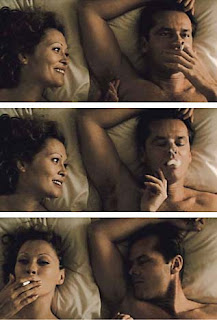
Faye Dunaway and Jack Nicholson in Chinatown
This scene shown in the images above is a particularly interesting and clever one. It takes place just after Mrs. Mulwray and J. J. Gittes had made love, and Gittes is smoking a cigarette. Mrs. Mulwray is asking questions about Gittes' past, when he was a policeman in Chinatown, and the viewer learns that his experiences there weren't too positive. He is shown smoking throughout the conversation about his unpleasant past, and he then says 'You can't always tell what's going on' (referring to Chinatown) and then turns towards Mrs. Mulwray and says 'Like with you', then at that moment Mrs. Mulwray reaches to her right and brings her cigarette in her right hand into the shot and inhales. This could be a hint that Mrs. Mulwray also has a hidden, unpleasant past, with the cigarette acting as the metaphor. If we assume that this is the case, then this is surely another example of the theme of the haunted past.
It is no surprise, then, that, due to all of these narrative and characterization structures, Chinatown has been dubbed a ‘neo-noir’ by many critics. There is, in fact, further evidence of this in the shape of parts of mise-en-scene which help to reflect aspects of the narrative. The use of venetian blinds, for example (as explained in my ‘Thriller Conventions’ essay earlier) are used to reflect the seclusion of the events in the room (in this case Gittes’ office and various offices at the head of the water company) for they are corrupt and hidden away. The consistent inclusion of a black fan spinning in the mise-en-scene of Gittes’ office is also a generic signifier, and (again, as explained in my ‘Thriller Conventions’ essay) reflects the complexity of the narrative, and also, in a way, helps to build tension as the viewer sees the fan spinning again and again, and wonders when the ‘you know what’ will hit the fan. Although the narrative itself is very complex, the way in which it is told is fairly simple.
There are no flashbacks or toying with chronology in order to confuse the audience, the story is told in perfect chronological order, letting the twists and the new information come to light naturally. This use of narrative, in my opinion, makes the twists, especially those of ‘the haunted past’ of Mrs. Mulwray all the more shocking, as there had been very little, if any, clues to suggest the case as there surely would have been with the use of flashbacks. Also, many would argue that the plot-line is complicated enough without any deliberate attempts to confuse the viewer (such as those of the techniques used in Memento (2000)). This simplified use of story-telling, then, is not something that’s too common in thrillers, as many of them tend to include things like flashbacks or other variations of chronology, deliberately included to confuse and disorientate the viewer. However, those techniques, as mentioned in my ‘Thriller Conventions’ essay, are more often than not used in films where the protagonist has suffered from memory loss or been in a coma, and therefore is disorientated themselves, but in Chinatown this is clearly not the case. Gittes, in fact, has to be orientated, has to know what he’s doing and where he’s going so that he remains in control of the case. If, then, a disorientating form of story-telling is used to reflect the disorientation of the protagonist, then in Chinatown the straightforward form of story-telling reflects the control of Gittes – and, if the plot-line is complicated enough without confusing story-telling for the viewer, then it’s the same for Gittes. Both the viewer and Gittes need the narrative to be told in a straight-forward way, so they both have a chance of remaining in control and getting to the bottom of the case.

Jack Nicholson in Chinatown
In terms of narrative development, Mrs. Mulwray, and not Gittes, is really the focal point of everything. It is through her that we meet almost every other character in the film, and the major twists of the plot all revolve around her, and not around Gittes. Gittes isn’t directly involved with any of the events that take place after the first twenty minutes of the film, he’s simply in it because he wants to dig deeper and find out the truth, as does the viewer, so, going back to the use of first person narrative, Gittes is merely a gateway between the viewer and the film and we’re following the plot through his eyes. This, in itself, is a hint at voyeurism, as the viewer follows Gittes in order to follow the plot, which, incidentally, is an important genre convention. There are, in fact, a number of hints of voyeurism in Chinatown, as it is really a key theme in any film where a private investigator is the protagonist.
In conclusion, there are several narrative conventions in Chinatown, which, as mentioned, are largely related to the noir period. There are however, less conventional aspects of the narrative too. The most important one being that of the false assumption of Mrs. Mulwray as a femme fatale, as this uses the conventions in order to create a false assumption, and this then creates the most important twist of the film. A mixture of both conventional and unconventional aspects seem to work the most effectively in most films and not just Chinatown, so this is something we can definitely learn from and look to try and incorporate into our own production.


