Showing posts with label G321 Preliminary task. Show all posts

Sunday, 8 February 2009

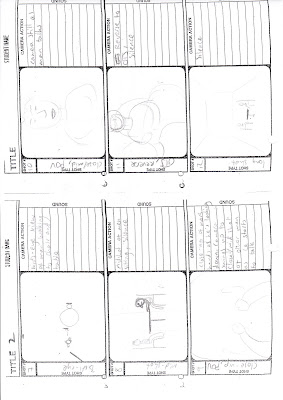
Preliminary Task: Story Boards


Thursday, 5 February 2009

Preliminary Task: Final product
Below is the video of our preliminary task:

Thursday, 8 January 2009

Continuity Task Script


IN CORRIDOR. CAMERA TRACKS TOM down the corridor. CUTS to interior of room. CHARLIE is already sitting at the table, TOM walks to the table and sits opposite her.


TOM
Ok Charlie, now we’re all here to
help you but you have to talk to us.

CHARLIE
(silence)

TOM
Come on we can never bring this
man to justice if you don’t help us.

CHARLIE
(silence)

[Gives evil stare and raises middle finger]

TOM

Now there’s no need for that.

CHARLIE
(silence)

TOM
Fine have it your way!!!

[Turns, walks out the room, slamming the door]

Wednesday, 7 January 2009

Shooting maps for our preliminary filming task
These are our shooting maps for our preliminary filming task. These show the camera positions for each of our shots and demonstrates that we didn't cross the 180 degree line, in relation to the 180 degree rule.


Monday, 5 January 2009

Preliminary filming task: Evaluation
We followed three key concepts which relate to continuity editing in our preliminary filming task, and these were: match on action technique, shot/ reverse shot technique, and the 180 degree rule. It was vital that we followed these as a failure to do so would have jeopardised the audience's understanding of the film, immediately causing our film to be a failure. However, we also used several different types of shots, such as close-up, long-shot, over-the-shoulder shot and birds-eye shot in order to add variety and interest. We also used techniques to add variety and interest in editing, such as making the film black and white, just to make it a little different.
During this task, we also used new technologies and techniques, such as the non-linear editing software, which was new to everyone in our group, therefore our skills with it were fairly limited. Because of this, it may well be that our shot transitions are not as smooth as they could be. Many of our different shot types were a new technique to us too, especially the more difficult ones like the high-angle long shot at the beginning, the zoom-out and pan from the clock to the door (this shot turned out to be especially shaky) and finally, the birds-eye shot.
Despite some of these difficulties we encountered regarding the new techniques, I feel that overall our final product meets the original brief, as it follows the three key concepts that we set out to achieve, and, with our variety of shots, it also includes several points of interest.

Saturday, 3 January 2009

Continuity Editing

Match on action technique

This is a technique used to preserve temporal continuity where there is an unrepeated physical motion in the same passage between two or more shots. A match on action is when an action occurring before the temporally questionable cut is picked up where the cut left it by the shot immediately following, in other words the same physical motion carries on at the same place into the next shot from the previous shot. If this is unsuccessful (i.e. a part of the motion is left out between the shots) then it leads to discontinuity and could leave the viewer disorientated.
An example of a match on action could be in a scenario where a man is lifting his gun and this action is shown at a mid-shot and then a close-up shot. Clearly, if a part of the action of lifting up his gun is missed out then the action seems unrealistic and therefore unbelievable. In our own continuity sequence and example of match on action is the part of the man walking through the door and into the room, as we are filming him from behind as he walks through the door and then wait for him inside the room when he walks into the room. If the action of walking through the door in the shot from the room is different to that in the previous shot, then it will be unrealistic and unsuccessful.

Shot reverse shot

This is a technique in which two or more characters/ objects are required, and it consists of the camera focusing on one character/ object that is looking at the other character/ object who is off-screen, then the shot switches to the second character/ object looking “back” at the first character. Since the characters are shown facing in opposite directions, the viewer assumes that they are looking at each other.

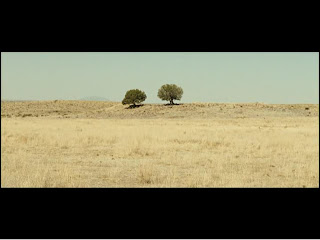
An example of shot reverse shot from No Country For Old Men:


The 180 degree rule

This is a technique used to prevent viewer disorientation. It is based on the concept that the two or more people or objects in the shot should always have the same left/ right relationship to each other. This is achieved by making sure that the camera doesn’t pass over the imaginary axis connecting the two subjects. Passing this axis is known as crossing the line, and results in upsetting the left/ right relationships between the subjects in the shot. This shot, from the opposite side, is known as a reverse angle.

Diagram of the 180 degree
rule: