Tuesday, 13 January 2009

Thriller planning: Props

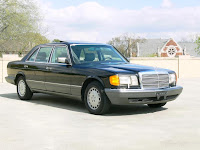
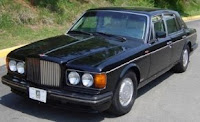
The car: preferably black, dark blue or any shade of colour that doesn’t draw attention to itself. As it is a car of an organised crime group it can’t be too flashy or too big but has to be reasonably fast, in case of any car chases from police or other gangs. Something in the way of a slightly aging luxury car (although probably with a modern and much larger engine) would be the ideal option, such as this 1990 Bentley Turbo R:

Or this 1990 Mercedes 350SDL:

In reality, however, we know that these cars would be unattainable, so more realistic targets would be just a dark coloured sedan car that is preferably quite a sought after brand, and not too modern either because the car isn't a fashion gimmick, but is probably a few years old by now. Realistic targets would be something like a 1999 Saab 93 sedan or a 1999 BMW 528i as shown below:


In the end we managed to secure the use of a very dark blue Saab 93 sedan, as a group member's father owns one. We are very pleased with this as it was one of our original 'realistic targets'.

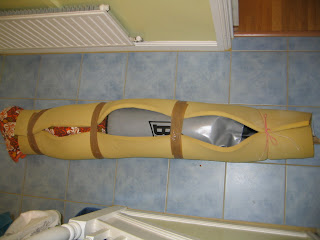
The dead body: This could be many things: pillows/ rolled-up duvet/ sand/ punch bag. Probably the punch bag would be the best option, as it is heavy enough to make a sound and for the actors to have some difficulty carrying it. Also, it is easily attainable, as a group member has one in his garage.
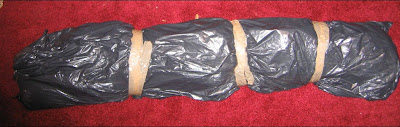
In the end, we decided on using the punch bag, filled out with various pillows/ duvet and then wrapped in black bin-liners and sealed with brown tape:


Cigarettes and Zippo lighters: you can’t have criminals that don’t smoke. Zippo lighters would be used to give the characters in the opening a more sophisticated look and impression of higher status (working for one of the biggest gangs).

Unfortunately however, we were not able to get hold of a zippo lighter, so we will use a regular lighter instead. This is a shame but the difference probably won't be huge to the viewer as it will be dark and the hand of the smoking person would cover up most of the lighter anyway.

The desk: Ideally this could be a mahogany desk that’s quite wide, something that’s grand and sophisticated in order to reflect the characteristics of the crime-lord behind it. It may also be quite old-fashioned rather than modern as the boss is fairly old, so maybe a darker rather than lighter shade of brown.

However, we will have to take what we are given, especially as we are filming in a classroom. But, it will be very dark so the desk itself and its colour and size would barely be visible (if at all).
The big chair: Again, it would ideally be something grand, and possibly out of leather.
But, again, we will use what is in the classroom already as we do not have such a huge choice, and due to the darkness in the room the chair itself won't be hugely visible either.
Costumes: The gangsters in the car would be wearing dark clothes and a large dark coat, as they are the 'muscle' guys doing the dirty work, so they would hardly be wearing flashy white suits.

The boss, on the other hand, would be wearing a dark suit with a shirt and tie. Although not white either, the suit would be quite smart and very very expensive.

Although all of our 'ideals' for the props sound very grand, expensive and glamourous (which also makes them unavailable to us), they would not be presented in a glamourous way (should they have been available), as our opening will be dark, shadowy and rather unglamourous. They would have been used, though, to show that the business of the characters does pay and they have success in it, but then they also end up dead as a result, and although they have money they certainly meet unglamourous engings.

Thursday, 8 January 2009

Continuity Task Script


IN CORRIDOR. CAMERA TRACKS TOM down the corridor. CUTS to interior of room. CHARLIE is already sitting at the table, TOM walks to the table and sits opposite her.


TOM
Ok Charlie, now we’re all here to
help you but you have to talk to us.

CHARLIE
(silence)

TOM
Come on we can never bring this
man to justice if you don’t help us.

CHARLIE
(silence)

[Gives evil stare and raises middle finger]

TOM

Now there’s no need for that.

CHARLIE
(silence)

TOM
Fine have it your way!!!

[Turns, walks out the room, slamming the door]

Wednesday, 7 January 2009

Shooting maps for our preliminary filming task
These are our shooting maps for our preliminary filming task. These show the camera positions for each of our shots and demonstrates that we didn't cross the 180 degree line, in relation to the 180 degree rule.


Monday, 5 January 2009

Preliminary filming task: Evaluation
We followed three key concepts which relate to continuity editing in our preliminary filming task, and these were: match on action technique, shot/ reverse shot technique, and the 180 degree rule. It was vital that we followed these as a failure to do so would have jeopardised the audience's understanding of the film, immediately causing our film to be a failure. However, we also used several different types of shots, such as close-up, long-shot, over-the-shoulder shot and birds-eye shot in order to add variety and interest. We also used techniques to add variety and interest in editing, such as making the film black and white, just to make it a little different.
During this task, we also used new technologies and techniques, such as the non-linear editing software, which was new to everyone in our group, therefore our skills with it were fairly limited. Because of this, it may well be that our shot transitions are not as smooth as they could be. Many of our different shot types were a new technique to us too, especially the more difficult ones like the high-angle long shot at the beginning, the zoom-out and pan from the clock to the door (this shot turned out to be especially shaky) and finally, the birds-eye shot.
Despite some of these difficulties we encountered regarding the new techniques, I feel that overall our final product meets the original brief, as it follows the three key concepts that we set out to achieve, and, with our variety of shots, it also includes several points of interest.

Sunday, 4 January 2009

Thriller planning: Soundtrack
One of our initial ideas for the soundtrack of our thriller is from Sergei Prokofiev's ballet 'Romeo and Juliet', the specific track being 'Montagues and Capulets'. We like this piece because its very powerful and sinister, and would fit in well with a theme of betrayal and deception. This soundtrack, being a classical piece, would give our thriller a more classic style.
Another idea for our soundtrack was to have something more modern, that isn't a classical piece, and that is dark and industrial. Something similar perhaps to the soundtrack from the opening sequence of Sin City, or perhaps something like an instrumental version of something by Marylin Manson. Should we choose to go with a piece like this, our thriller would definitely have a more modern style.

Saturday, 3 January 2009

Thriller planning: Storyboards


Continuity Editing

Match on action technique

This is a technique used to preserve temporal continuity where there is an unrepeated physical motion in the same passage between two or more shots. A match on action is when an action occurring before the temporally questionable cut is picked up where the cut left it by the shot immediately following, in other words the same physical motion carries on at the same place into the next shot from the previous shot. If this is unsuccessful (i.e. a part of the motion is left out between the shots) then it leads to discontinuity and could leave the viewer disorientated.
An example of a match on action could be in a scenario where a man is lifting his gun and this action is shown at a mid-shot and then a close-up shot. Clearly, if a part of the action of lifting up his gun is missed out then the action seems unrealistic and therefore unbelievable. In our own continuity sequence and example of match on action is the part of the man walking through the door and into the room, as we are filming him from behind as he walks through the door and then wait for him inside the room when he walks into the room. If the action of walking through the door in the shot from the room is different to that in the previous shot, then it will be unrealistic and unsuccessful.

Shot reverse shot

This is a technique in which two or more characters/ objects are required, and it consists of the camera focusing on one character/ object that is looking at the other character/ object who is off-screen, then the shot switches to the second character/ object looking “back” at the first character. Since the characters are shown facing in opposite directions, the viewer assumes that they are looking at each other.

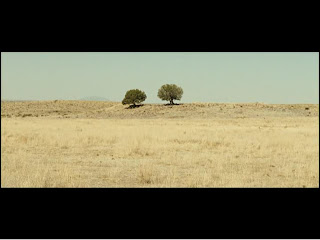
An example of shot reverse shot from No Country For Old Men:


The 180 degree rule

This is a technique used to prevent viewer disorientation. It is based on the concept that the two or more people or objects in the shot should always have the same left/ right relationship to each other. This is achieved by making sure that the camera doesn’t pass over the imaginary axis connecting the two subjects. Passing this axis is known as crossing the line, and results in upsetting the left/ right relationships between the subjects in the shot. This shot, from the opposite side, is known as a reverse angle.

Diagram of the 180 degree
rule: